skip to Main Content

Invoxia NVX 610: Executive Desk Phone Powered by iOS Device
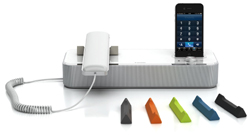
As it happens, I was travelling last week so not able to attend the VUC call on September 30th that featured Invoxia. Thank goodness for the podcast because their product, the NVX610 certainly looks interesting.

In fact, it’s interesting on many levels. For the past few years there have been a number of people I know who have been seeking a re-imagining of the desk phone. Fellow blogger Dave Michels is one of the more notable folks calling for such an effort.

In exploring the space looking for a solution to our latent desire for a wholly new kind of executive desk phone we’ve been distracted by various things.

Read More

Asterisk 10 In SSSSuuuuuuuper-Wideband!*

While I am not currently an Asterisk user I still try to stay in touch with what goes on in that realm. Earlier this week Rod Montgomery penned a post at the Digium blog entitled “Top 10 Tricks You Didn’t Know That Asterisk Could Do.”

The post is structured like a Top 10 list. Most of the items included are genuinely useful. However, right at the bottom in the #1 position, he highlights newfound support for very high-sample rate audio, aka Super-Wideband.

Read More

New Polycom Soundstation Duo Conference Phone

soundstation-duo-lg-a-250Early in 2010 Polycom introduced an addition to their legendary Soundstation line of conference phones, the Soundstation IP5000. (pictured right) I was lucky enough to get one for review and found it very attractive for the small office and home office user.

While I was on the exhibit floor at ITExpo last month I saw what looked like a Soundstation IP5000 at the Netx booth. However, looking a little closer I found it wasn’t a Soundstation IP5000 at all…it was a new model called the Soundstation Duo.

Read More

Magic Jack Plus Finally Shipping

magic-jack-plus-300 After being announced to much fanfare at CES 2011 it seems that MagicJack Vocaltec is finally shipping their new MagicJack Plus. The MagicJack Plus device still has a USB plug permitting its use with a computer. However, it also has a network jack allowing it to function as a freestanding FXS device, not unlike a traditional ATA.

This dual-mode operation offers greater flexibility in the face of competition from the like of NetTalk, whose “Duo” interface device doesn’t require the use of a computer. It also answers the wishes of people who have been hacking thin clients to provide a low-cost, low-power platform to host their Magic Jack service*.

The New York Times’ Gadgetwise makes mention of Magic Jack Plus in a piece that is largely focused on Skype’s new home phone line interface device. Over at the Unofficial Magic Jack Support forum users have reported the MJ+ devices started to arrive mid-August. 

Read More

HDVoice: On The Cheap & Analog RJ-11 Style

HDVoice RJ-11 Wall Plate A short while back I addressed the question of how DECT & CAT-iq may foster the broad deployment of HDVoice. At that time I described one possible scenario where carriers would deploy customer premises equipment (CPE) with an on-board cordless base station. Although a frontrunner, and the basis of Comcast’s (decidedly non-HD) HomePoint service, this is not the only approach afoot. There’s another possibility arising that involves conveying HDVoice over a plain old analog RJ-11 connection.

At first glance HDVoice and analog lines would certainly seem to be mutually exclusive. The common wisdom is that wideband telephony requires the use of an all-IP call path. This is in fact a generalization, and not absolutely true.

Firstly, it has long been possible to pass wideband audio, in the form of G.722 encoded media, over the PSTN by way of ISDN connections. Also known as BRI interfaces, an ISDN connection supports  up to two 64 kbps channels (bearer channels) and one D channel for the purposes of call setup & teardown signaling. High-quality voice using G.722 was one of the selling points of ISDN in the 1980s.

Read More
Back To Top