


USB attached audio devices are handy when you have a computer readily available. Being USB attached they save you the trouble of finding a way to provide network connectivity for a traditional IP conference phone.
However, most of the USB attached speakerphones that I’ve tried are intended for use by an individual. Like the speakerphone feature of a desktop phone they have directional sound pick-up, being more sensitive to sounds from the front. For personal use this is usually a good way to reduce background noise.


There is also considerable difference between the speakerphone feature of a desk phone and a proper conference phone. Just as a desk phone is not appropriate for use on a conference room table, a personal USB speakerphone is less than ideal for use when you have several people who need to be engaged in a call.
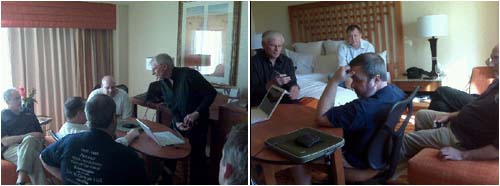

In the post-roll of Astricon 2009 Randy and I were trying to engage a room full of conference attendees, joining them to a conference bridge so that we could conduct a VUC session. We used the tools that we had available at the time, which included a Clear One Chat 50 USB personal speakerphone.


While it would be easy to say that the Chat 50 sucked, that would not be fair to the device. It was simply not the right device for the task at hand.
What we needed was something that was omni-directional in audio pickup and could generate louder output to be heard in a room full of people talking. It would also be handy if it had greater microphone sensitivity, giving it more reach into the room.
Since that day I have been seeking to try something more appropriate for that kind of a situation. When it became apparent that Tim Panton was going to be able to arrange for a group of Asterisk developers to join a VUC call from Astricon 2010 I decided to take the plunge and purchase the larger Clear One Chat 160. Drop shipped to the host hotel, Tim could use it to join the call when the group was assembled.


The Clear One Chat 160 is a Skype Certified audio device. This gave Tim some comfort as he would be using Skype on an older MacBook at Astricon. Whether connected to Windows or a Mac the Chat 160 is recognized as an USB audio device and does not require a driver be loaded.
It’s conveniently powered from the USB bus. No external power supply is required. No batteries to change.
While the Chat 50 is a small device, it looks kind of “chunky.” Measuring 4 x 4 x 1.5″ inches the Chat 50 is small enough to be portable but it’s not really an ideal form factor for life in your laptop bag. The Polycom C100S is an example of a similar device that’s a more ideal size & shape for life with a road warrior.
Measuring 7.5 inches square the Chat 160 is much larger. However, the fact that it remains only 1.25 inches tall makes it relatively transportable. It slides nicely into one of the document areas of my HP laptop bag.
The Chat 160 has one centrally mounted loudspeaker, ringed by an array of three microphones. Each of the microphones feature a cardiod pickup pattern but as they form a ring the device as a whole is omni-directional.


The case of the Chat 160 is comprised of an upper and lower half, joined by way of some shock absorbing rubber. This construction, while difficult to see in a photo, helps isolate the microphones from vibration or impacts to the tabletop.
The Chat 160 has three simple controls; volume up/down and microphone mute. All three are rubbery buttons that seem very durable.
When the Chat 160 is plugged into a USB port an array of three LEDs, one at each mic position, light up in blue. When the mic mute function is engaged the LEDs change to red.
Another series of LEDs arranged in an arc indicate the current volume setting. Tapping the volume up/down buttons repeatedly varies the output level.
Having considered it’s various physical attributes now comes the question of how well it works? My first time hearing it was when Tim used it at Astricon 2010. As I recall Tim was connected to ZipDX via Skype, so not in wideband. Even so, as a listener I thought it sounded pretty decent.
Since then I’ve used it around my home office a number of times, mostly in G.722 based wideband. To my ear it sounds fine. But my ear is not necessarily instrumentation grade, so I’ve made a sample recording to have some measurable results to look at.


This recording was made by recording directly into Cool Edit Pro v2.1 at 16 bits in mono with a sample rate of 48 kHz.
I tried to be consistent with the testing technique I used previously with the Yamaha PSG-01S. I set my dining room table up like it was a small board room, then walked around the table to each of the four side, speaking a little at each location.
Happily, the Chat 160 proved to be truly omni-directional. The recording level was consistent regardless of my location.

In the spectral graph of the recording I’ve added a pair of lines denoting 4 kHz and 8 kHz on the vertical axis. Even though the sample rate of the recording was very high it’s clear that the Chat 160 rolled off the high-frequency response just below 8 kHz. So while it’s perfectly satisfactory for G.722/G.722.1 based wideband telephony, it’s not quite up to the best capabilities of “super-wideband” codecs like SILK, CELT, or G.722.1C. Nonetheless it seems more than satisfactory for common voice applications.

Unlike another USB attached conference phone that I’ve tried, the Chat 160 showed no sign of problems with unacceptable noise level or DC shift in the output.
The absolute output of a bus-powered USB device is in part limited by the amount of power available to drive the output amplifier. The Chat 160 output seems loud enough to service a small room with 3-5 people around a table, just like the situations we faced at Astricon.
I purchased my Chat 160 from Amazon.com for $330. At that price it’s certainly not cheap, but it’s not unreasonable either. Most personal speakerphones are in the $140-200 range, but are simply not appropriate for use with a group. A freestanding SIP conference phone, like the Polycom Soundstation IP5000, costs over $400 but is much less convenient for portable applications.
I accept that not everyone needs a portable, USB attached conference phone. It’s clearly a niche application. If it happens that you have such a need, I find the Clear One Chat 160 to be worthy of consideration.