


Sez he:
Headset/Headphones: I prefer the term headphones. I think headset implies a voice microphone and headphone implies audio or speakers only. Those distinctions are obsolete. Modern microphones are small, cheap, and sensitive. They no longer need to be in front of the mouth, so can be placed invisibly on headphones. Since most devices now support speech or voice, it’s just silly to get headphones without a microphone. Now that we’ve cleared this up, I am only using “headphone” below.
I take issue with his simplistic view of microphones, and especially the significance of microphone placement. If you truly care about how you are conveying your voice then a boom mounted microphone is a must! Accept no substitutes.
If, on the other hand, you are more concerned about not looking geeky…go whatever path tickles your fancy. Enjoy those Beats By Dr Dre


To be fair, not everyone needs to be as demanding as I may seem. But do bear in mind that, with respect to microphone placement, you won’t ever know has bad you sound. It’s the people you’re trying to talk to who will suffer undue influence of the barista calling out orders, or the Gaggia steaming up that milk. What? Doesn’t everyone work at Starbucks or Panera these days?
I am especially troubled by inline microphones in headphones that are otherwise fine for listening to music. Dave refers to some headphones from Etymotic Research. I gather that his are some that don’t include a microphone. I used their ER-6i for years, which are discontinued but still supported. No microphone. Just music. More recently have been using their HF5

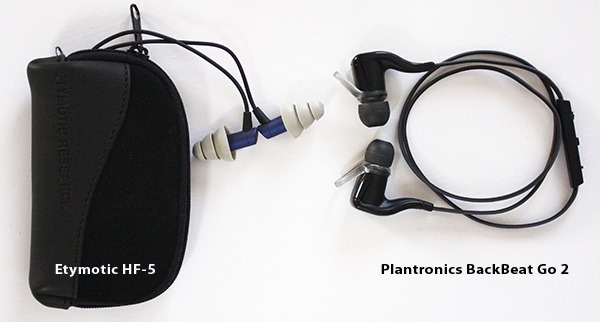

A headset like this clearly puts music first. They’re fine for when you are listen to music and interrupted by a phone call, but I wouldn’t plan to use them to attend a conference call where I was presenting. The inline microphone is non-directional, and not noise reducing. It would allow the noise of my surroundings to potentially distract my audience.
No, I’d plan to attend such a call from a quiet, distraction-free place where I could focus. I’d use a headset that allowed me to keep my hands free, and let the audience focus on my message.
Here’s a somewhat related illustration of this area of concern. There’s a neat new service called VoiceBoxer that aims to make it practical to give live webinars in multiple languages. The service allows interpreters to follow a presenter, delivering live interpretation. It’s great idea to make webinars more globally engaging in real-time.


If you watch the VoiceBoxer demo (requires sign-up, but seems innocuous) you hear a woman speaking in English. If you select another language you hear the interpreter. The interpreters are very clearly wearing a proper headset, where the English presenter was not. She sounds like she’s in a small, drywall room. Her sound is thin, and very reverberant. In contrast, the interpreters sound great!
As someone in the audience this raises some questions. Surely it would be easier for the interpreters if the presenter had better sound? Did she not know? Or simply not care? Was it not worth the trouble?
That’s where poor audio quality has it’s most dangerous impact. It may leave the impression that you either don’t know any better, or simply don’t care…neither of which support you in whatever you’re trying to convey. Poor audio quality undermines your message.
Returning to Dave’s UC Strategies post, I understand and accept the core of Dave’s argument. For some the distinction between good/bad audio, headset/headphone are not important. They simply may not care. Convenience trumps all else.
The service that I do in my contrarian viewpoint is to give you, dear reader, an advantage. If you you know better. If you do care, then you may better get your message across, whether it’s getting that next round of VC funding, or merely ensuring that you pass on those late additions to the grocery list. Communicating well never happens by accident.
I admit that the user context matters. In the home office, where Dave uses a Savi 700 Series headset, the boom microphone is easier for most people to handle. Paradoxically, it’s out in the wilds of the world, where noise abounds, that such a tool would deliver the greatest benefit.
Curiously, it seems that Dave and I have used much the same hardware. I presently have the Plantronics BackBeat Go 2


I still admire my Sennheiser DW Pro 2 DECT headset. It’s longevity and continuous performance are testament to it’s value. It surely was expensive, but it just keeps marching on…even now that it’s been displaced by the newer SD Series DECT wireless headsets