

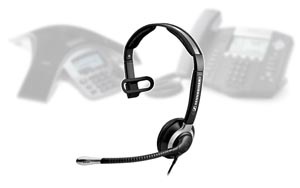

Anything that helps to make your message more clearly gives an advantage. Inversely, anything that makes it more difficult to communicate is, in reality, a threat to your business. This principle should be your guide as you select equipment for your small office or home office.
When considering home office telephony the technologically inclined often get bogged down in debate about the use of traditional phone service vs various forms of IP telephony. This is a big issue, with many complexities to be considered. However, there is a simpler issue that can have a dramatic impact on the enhancing your ability to communicate clearly; do you have a good headset?
My home office is I suspect fairly typical. At around 360 square feet it’s spacious for a home office. It’s a dedicated space with room for me to work, even create hardware havoc when necessary. I share the space with my ever-present office-assistants; our two Labrador Retrievers.


Typical of many homes, my office features drywall on the walls and carpet on the floor. If you stand in the middle of my office on a typical day you hear the accumulated sounds of various computers, office equipment, a ceiling fan and the air conditioner. It’s actually pretty quiet. I like it that way.
Having spent much of my career around broadcasting and recording studios I’ve learned that every room has something called “room tone.” It’s the ambient noise innate to the space. It stems from the combination of the various things occupying the space, external sounds from nearby, along with the nature of the rooms construction.
A room may be quiet, but it’s rarely ever silent. When recording voice the greater the distance between the microphone and the singer the more the room tone impacts the captured sound. The same holds true for telephony, except that you’re much less likely to sing.


However, even in my nearly idylic home office environment I rarely use a speakerphone. I almost always prefer to use a good headset for business calls. The reason is very simple; I want the person I’m calling to feel that they have my undivided attention. I want them to feel important.


Devoid of distraction, and hearing me very directly, they are left with the impression that they have my full attention. Ultimately, this reinforces the sense they are being handled professionally. They may never know that I work from home.
Alas, even a great headset doesn’t keep them from hearing the dog announcing the arrival of a Fedex delivery.
Beyond the convenience of being hands-free, wearing a headset actually gives you increased control of your presentation. Because it captures the voice so directly it allows you to use greater variation in inflection as you speak. Like a singer working a microphone while performing, it lets you be dynamic. Be quieter and times…then louder and more forceful as necessary to convey your message. Empathize or rant as necessary to effectively make your case.
There are times when it might be necessary to use a speakerphone. Those tend to be times when several people are gathered to participate in a call. In such circumstances there’s no substitute for great hardware.
When faced with a desktop speakerphone most people tend to simply shout in an essentially mono-tone manner. Further, their shouts are conveyed awash in room-tone. It certainly makes a statement. Often that statement is “I can’t even be bothered to lift the handset for this call” with a dash of “this is a tiny drywall box, similar to a jail cell.” Your clients’ impression of your care & concern can only be diminished.
So it is that, despite the fact that I have first class phones, with very good speakerphones, I see great value in keeping a couple of good headsets on-hand. Using the headsets results in a measurable sense of improved customer service. A headset simply makes it easier to communicate effectively.
This is no trivial claim, but you don’t have to take my word for it. You can decide for yourselves using the finest instrumentation available…your own ears.
To illustrate my point I present you with a pair of recordings. Both recordings are the very same instance of me reading the beginning of this post in my home office. The first is recorded using a high-quality speakerphone. The second is recorded at the very same instant using one of my favorite headsets. Give them a listen and judge for yourself.
[soundcloud url=”https://api.soundcloud.com/tracks/19305393″ params=”color=ff5500&auto_play=false&hide_related=false&show_comments=true&show_user=true&show_reposts=false” width=”100%” height=”166″ iframe=”true” /] [soundcloud url=”https://api.soundcloud.com/tracks/19305392″ params=”color=ff5500&auto_play=false&hide_related=false&show_comments=true&show_user=true&show_reposts=false” width=”100%” height=”166″ iframe=”true” /]There’s a substantial difference between the two recordings. Neither of them are really bad, but one is clearly better. One seems to be very clear and immediate, while the other has a sense of being at a distance. These samples were recorded in my relatively quiet office. In a more typical, noisier environment the advantage presented by the headset would be much more pronounced.
With the merits of using a headset now presented, some may want to consider wired vs wireless headsets. I’ll leave that for another day. For the moment I’ll close by returning to the question posed at the beginning; do you have a good headset?
I think you should.